
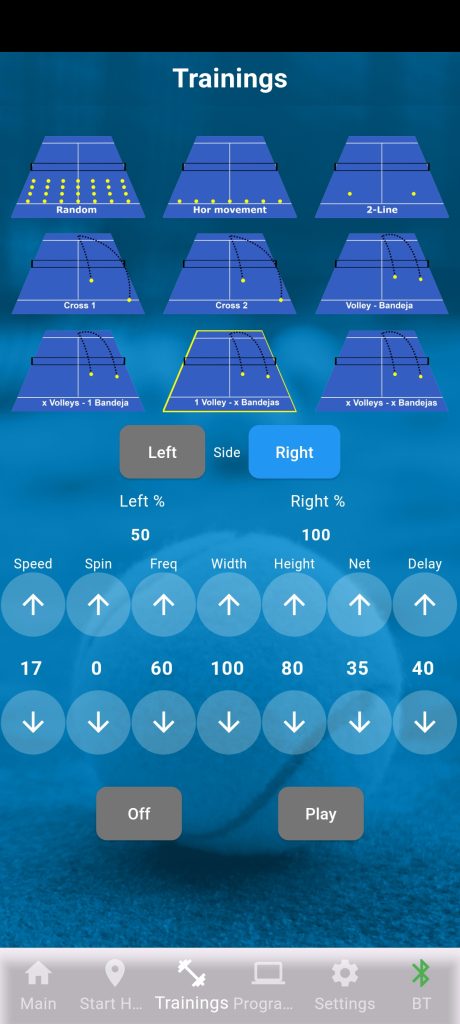
Walk into any sports equipment store or browse the top ball machine brands online, and you’ll quickly notice something: the vast majority of ball machines were designed for tennis. That’s not a coincidence — tennis has a far larger global market, and manufacturers built their machines accordingly. The problem? Padel is a fundamentally different sport, and a tennis machine adapted for padel is a bit like using a football for a basketball game. It kind of works, but not really.
The Volley-Bandeja Problem
One of the most basic tactical situations in padel is defending against players at the net. When your opponents are positioned at the net, the standard counter is to play a high lob over them — forcing them to retreat or respond with a bandeja. The bandeja is a controlled overhead with relatively low pace, designed to keep the player close to the net so they can immediately return to an attacking position. If the lob is deep enough, the net players are pushed back, and the dynamic of the point shifts entirely.
To train this realistically, a machine needs to deliver both fast, low volleys and high lobs — and ideally switch between them. Most conventional ball machines can do one or the other. Doing both in the same training session is rarely possible. The Padelshooter was built specifically to combine low and high balls in a single programme, giving players the ability to train this core padel scenario properly.
Timing Is Everything — And It Differs Per Shot
A bandeja takes significantly longer to travel from the machine to the player than a fast volley does. In real match play, the interval between shots varies naturally depending on the type of ball. Tennis machines are typically designed around consistent, fast ball delivery — fine for a baseline rally, but wrong for padel.
In the Padelshooter, the interval between balls is configurable per shot type within a single training. That means a volley sequence can fire in rapid succession, while a high lob gives the player time to reset position — just like in an actual match.
Where the Ball Goes: Zone Control
A standard tennis ball machine distributes balls across the full width and depth of the court. In padel, that level of spread is often too broad to train specific tactical patterns. The Padelshooter lets you restrict play to the left or right half of the court, and goes further still: you can define precise zones by depth (e.g. 75–100% of the court) and width (e.g. the rightmost quarter). This granular control allows coaches and players to isolate exactly the situations they want to work on.
The Random Factor: Training the Unexpected
In padel, your opponent decides whether the ball arrives low or high. You cannot know in advance. Many machines offer programmable sequences, but a fixed sequence means you always know which ball is coming next — which defeats the purpose of reaction training.
The Padelshooter includes a customisable random element in many of its built-in training programmes. In a volley-bandeja drill, for example, the number of volleys before a lob varies unpredictably. The lateral position also varies within a configurable area — so the ball might arrive to the forehand, the body, or the backhand, but exactly where within that range is left to chance. You can start with a narrow width and gradually increase it as your level improves. This mirrors the unpredictability of a real opponent far more closely than any fixed sequence can.
What the Competition Actually Offers
To be fair, a handful of brands have made attempts at padel-specific training. Spinfire, for instance, includes two padel drills in its offering. The first moves the ball height slowly between net level and lob height — a predictable oscillation that requires the speed to be dialled in precisely, because any deviation sends the ball into the net or the back wall. There is no lateral variation, and the height change is entirely foreseeable. The second drill delivers two volleys followed by one bandeja, with the volleys spread across the full court width and the lob always landing in the centre. That is not how padel is played. The ball intervals are also noticeably long, making the drill feel more like a demonstration than a workout. While the Spinfire is not that bad, the Slingerbag Padel (should be made for padel?) is even worse. Needs a separate plate for left/right movement, an extra block for shooting only high balls. And the traingings are very static and only made for 1 type of ball, no real match trainings.
These are not criticisms for the sake of it — Spinfire makes good machines for tennis. But two partially effective padel drills on a tennis-oriented machine is not the same as a machine built from the ground up for padel.
Custom Programmes: Low Balls Only?
Several machines on the market allow users to create their own training programmes. In practice, however, these tools are almost universally oriented around tennis: low, flat balls with speed and spin variation. High balls are either absent or an afterthought. The idea of combining low volleys and high lobs in a single custom programme — with random variation between the two — is simply not something these machines were designed to support.
The Padelshooter supports all training types: low balls, high balls, and any combination of the two. That is not a marketing claim — it is a direct consequence of having been designed specifically for padel.
Built for Padel, Not Retrofitted for It
Almost all ball machines are manufactured in China. That includes the hardware inside the Padelshooter. But manufacturing location is not what defines a machine — software does. The vast majority of brands develop their software in countries where padel is barely played, by engineers who have never stood on a padel court. The result is padel features that look right on paper but miss the nuances that any regular player would immediately notice.
The Padelshooter uses Chinese hardware to keep costs manageable — a fully European-manufactured machine would be significantly more expensive. But every line of software and every feature in the app was developed in the Netherlands, on actual padel courts, by people who play the sport. When critics dismiss the Padelshooter as a “rebranded Chinese machine,” they are missing exactly this point. The hardware is a commodity. The software is what matters — and that is entirely homegrown.
Incidentally, the Padelshooter has since added tennis functionality, and a growing number of clubs and coaches now use it for tennis training precisely because of its advanced programming capabilities. It turns out that a machine genuinely designed to handle complex, multi-shot padel drills is also rather good at tennis.
The Bottom Line
If you are serious about improving at padel, training with a machine that was designed for a different sport will always be a compromise. The shots are different, the timing is different, the tactics are different. The Padelshooter was built to train padel the way padel is actually played — with high balls, low balls, random variation, and the kind of zone control that lets you target exactly the weaknesses in your game. That is not something you can bolt onto a tennis machine after the fact.